
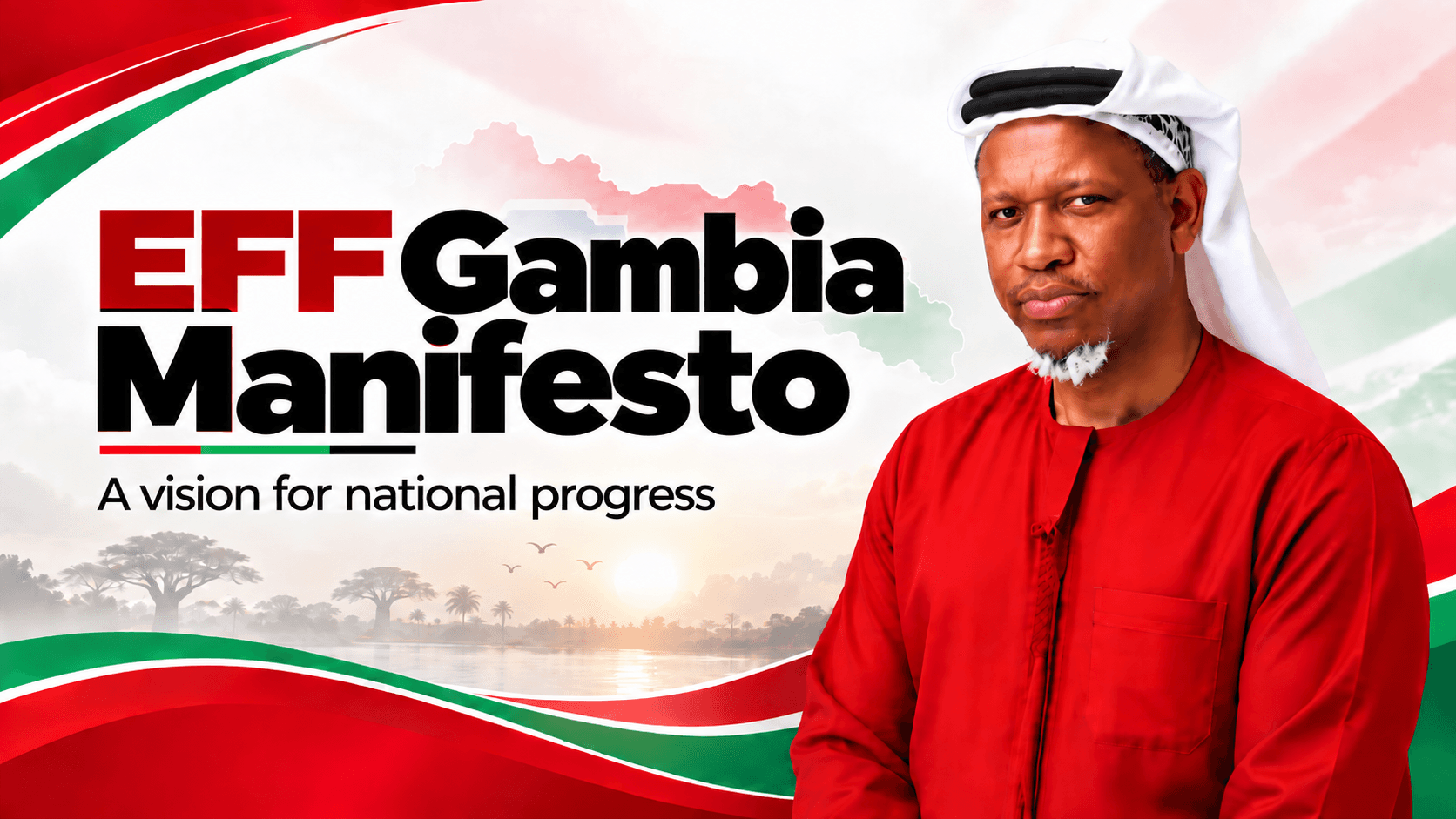
Economic Freedom Fighters (EFF) – The Gambia
MANIFESTO 2027 – 2037
A Philosophy for National Renewal: Shared Values. Shared Prosperity.
Prince Ebrahim Sanyang
"A nation's greatness is measured not by what it consumes, but by what it produces; not by the wealth of a few, but by the opportunities available to all; and not by the promises of its leaders, but by the progress of its people."
— Prince Ebrahim Sanyang
A Ten-Year National Transformation Agenda
EFF – The Gambia | Comprehensive Manifesto 2027 – 2037
Preamble
The Economic Freedom Fighters (EFF) presents this Comprehensive Manifesto to the people of The Gambia as a solemn covenant between a movement and a nation. It translates the philosophical foundation of The Charter into concrete, measurable, time-bound commitments across every sector of national life – and it goes further, by anchoring delivery at the district level, where real life happens.
This Manifesto is not a collection of empty promises. It is a costed, sequenced, and accountable plan for national renewal. It recognises that the challenges facing The Gambia – unemployment, poverty, weak infrastructure, food insecurity, energy deficits, and institutional fragility – are not natural disasters. They are the product of choices made and choices avoided. Different choices, made with discipline and vision, can produce different outcomes.
The EFF Manifesto rests on seven foundational pillars, each delivering visible, tangible benefits to every district:
- Economic Freedom and Productivity
- Human Capital and Social Justice
- Infrastructure and Digital Transformation
- Governance, Rule of Law, and Institutional Integrity
- National Unity and Strategic Sovereignty
- District-Level Investment Agenda (NEW – Regional & District Industrialisation)
- People's Livelihood Programme (NEW – Ambulances, Buses, Elderly Payments, Youth ICT)
Each pillar is anchored in specific commitments, with indicative timelines and financing strategies. The EFF commits to publishing annual progress reports against every commitment, subject to independent audit and public scrutiny.
Pillar One (1): Economic Freedom & Productivity
Chapter 1: A Productive Economy That Creates Jobs
1.1 The Vision
The Gambia's economy has historically been characterised by dependence on a narrow range of sectors – tourism, remittances and re-export trade with limited industrial production, weak agricultural productivity and a small formal employment base. The EFF vision is to transform The Gambia into a productive, diversified and export-oriented economy that creates at least 250,000 new jobs over ten years.
1.2 Agriculture & Food – Commitments
- Achieve rice self-sufficiency within 5 years. Target: 400,000 metric tonnes of domestic rice production annually by 2031.
- National Agricultural Transformation Fund – USD 500 million for low-interest credit, insurance, and technical support to smallholder farmers, particularly women and youth.
- Guaranteed minimum farm-gate prices for groundnuts, rice, maize, and horticultural produce.
- Modernise the groundnut value chain – Target: 60% of groundnuts processed locally by 2032.
- Expand irrigated agriculture – Target: 50,000 hectares of newly irrigated land by 2033.
- Livestock development programme – restocking, veterinary services, and market infrastructure.
- Fisheries and blue economy – modernise landing sites, provide cold-chain infrastructure, develop aquaculture.
1.3 Tourism & Creative Industries – Commitments
- Reposition The Gambia as a premium, year-round destination.
- Tourism Infrastructure Development Fund – USD 900 million.
- National Creative Arts Council – fund music, film, fashion, and digital content.
- Protect and restore heritage sites – Kunta Kinteh Island, James Island.
1.4 Manufacturing and Industrialisation – Commitments
(As printed in the source document, this section repeats the Tourism commitments from 1.3.)
- Reposition The Gambia as a premium, year-round destination.
- Tourism Infrastructure Development Fund – USD 900 million.
- National Creative Arts Council – fund music, film, fashion, and digital content.
- Protect and restore heritage sites – Kunta Kinteh Island, James Island.
1.5 Trade & Investment – Commitments
- Single Window Trade Facilitation – digital customs clearance.
- Investment Promotion Agency reform.
- Diaspora Investment Bonds – USD 1 billion targeted at Gambians abroad.
- Formalise the informal sector.
1.6 Small & Medium Enterprise Development – Commitments
- National SME Support Programme – credit at 8% interest.
- Youth Entrepreneurship Fund – USD 500 million.
- Women's Enterprise Development Fund – USD 300 million.
- Reduce cost of doing business – digitise registration.
1.7 Blue Economy & Maritime Services – Commitments
- National Blue Economy Strategy.
- Combat IUU fishing.
- Port modernisation – expand Banjul Port, develop deep-water facility.
- Maritime security – strengthen Navy and coast guard.
1.8 Mining & Natural Resources – Commitments
- Transparent mineral resource governance – publish all contracts, establish sovereign wealth fund.
- Environmental safeguards.
- Value addition – local processing.
1.8 Financial Sector Development – Commitments
- Mobile money and fintech development.
- Financial inclusion – target 75% of adults by 2030.
- Capital market development.
- Central Bank reform.
Pillar Two (2): Human Capital & Social Justice
Chapter 2: Investing in People
2.1 Education – Commitments
- Free and compulsory basic education – elimination of all hidden fees.
- Teacher training – recruit 5,000 new teachers over 5 years.
- School infrastructure – 500 new classrooms, rehabilitate 1,000.
- Digital learning – tablets and offline-capable platforms for all secondary school.
- TVET – 10 modern centres aligned with labour market.
- University expansion – increase UTG enrolment by 50%.
- Girls' education – scholarships, mentorship, safe school.
- Adult literacy – 200,000 adults over 5 years.
2.2 Healthcare – Commitments
- Universal Health Coverage – phased National Health Insurance Scheme.
- Primary healthcare strengthening – 1,000 community health workers.
- Maternal and child health – reduce maternal mortality by 50%, under-5 by 40%.
- Hospital infrastructure – expand EFSTH, new referral hospital in URR.
- Mental health – National Mental Health Programme.
- NCDs – national screening for hypertension, diabetes, cancer.
- Health workforce – 2,000 additional health workers.
2.4 Social Protection – Commitments
- National Social Protection Strategy.
- Old Age Pension – expand to all citizens over 65, minimum monthly payment.
- Disability Support Programme.
- Child Grant – targeted cash transfers.
- Food assistance – emergency support linked to agricultural development.
2.4 Youth Development & Employment – Commitments
- National Youth Service Scheme – civil service, skills training, employment placement.
- Youth Employment Tax Incentive.
- Digital Skills Programme – 50,000 youth trained.
- Sports and Recreation.
- Mental health and counselling.
2.5 Housing & Urban Development – Commitments
- Affordable Housing Programme – 20,000 units over 10 years.
- Slum upgrading & Urban Planning Reform.
- Rural housing – materials, technical assistance, microfinance.
Pillar Three (3): Infrastructure & Digital Transformation
Chapter 3: Connecting and Powering the Nation
3.1 Energy – Commitments
- Universal electricity access by 2035.
- Renewable energy – 50% in generation mix by 2035.
- Energy efficiency – national programme.
- Rural electrification – solar mini-grids for 500 villages.
- Power sector reform – strengthen NAWEC, private investment.
3.2 Water and Sanitation – Commitments
- Universal access to clean water by 2030.
- Sanitation for all – eliminate open defecation.
- Water resource management – protect aquifers.
- Irrigation infrastructure – 50,000 hectares.
3.3 Transport – Commitments
- Road network expansion – 2,000 km new and rehabilitated.
- Banjul Port expansion – deep-water berths.
- Banjul International Airport upgrade – regional hub status.
- Public transport reform – modern bus system.
- Ferry services – reliable, safe.
- Rail feasibility study.
3.4 Digital Transformation – Commitments
- National Fibre Optic Backbone – connect all regions.
- Digital ID for all citizens.
- E-Government Platform – digitise government services.
- Digital Payments – nationwide interoperability.
- Rural Connectivity – internet in all schools, health centres.
- Cybersecurity – national strategy.
- Innovation Hubs – Banjul, Brikama, Basse.
Pillar Four (4): Governance, Rule of Law, and Institutional Integrity
Chapter 4: A State That Serves
4.1 Constitutional Democracy – Commitments
- Defend the Constitution – no term limit extension.
- Free, fair, credible elections.
- Respect for opposition and dissent.
- Separation of powers.
- Independent institutions.
4.2 Rule of Law & Justice – Commitments
- Judicial independence.
- Access to justice – legal aid, rural courts.
- Poison reform (sic – as printed in the source).
- Police reform – community policing.
- Anti-corruption – strict enforcement.
- Land reform – transparent registration.
4.3 Public Service Reform – Commitments
- Merit-based recruitment.
- Digital government.
- Decentralisation – empower local councils.
- Public financial management.
- Citizen engagement.
4.4 Security Sector Reform – Commitments
- Professional armed forces.
- Police modernisation.
- Intelligence reform.
- Border management.
- Cybersecurity.
- Disaster preparedness.
Pillar Five (5): National Unity and Strategic Sovereignty
Chapter 5: One Nation, One Future
5.1 National Unity – Commitments
- Reject tribalism, sectarianism, discrimination.
- National dialogue – regular consultation.
- Inclusive Governance.
- Civic Education.
- National Symbols.
5.2 Foreign Policy & Diplomacy – Commitments
- Africa First – ECOWAS, AU.
- Sovereignty and Independence.
- Economic Diplomacy.
- Protect Gambians Abroad.
- Peacekeeping.
- International Cooperation.
5.3 Environmental Stewardship – Commitments
- Climate resilience – national adaptation plan.
- Forest and biodiversity protection.
- Coastal protection.
- Sustainable land management.
- Clean communities.
- Renewable energy.
Pillar Six (6): District-Level Investment Agenda
Chapter 6: Regional and District Industrialisation – One District, One Product
6.1 The Philosophy: Wealth Created Where People Live
The EFF rejects the model of development that concentrates all opportunity in Greater Banjul while rural districts are left as sources of labour and raw materials. Economic freedom means every district produces, every district earns, and every district exports.
The District Investment Agenda is built on the principle of "One District, One Project" (ODOP) – identifying and scaling the unique comparative advantage of each of The Gambia's 8 Local Government Areas (LGAs) and their 53 districts.
6.2 The National District Investment Fund (NDIF)
Commitment: Establish a USD 2 billion National District Investment Fund over 5 years, providing:
- Seed capital for district-level enterprises
- Infrastructure for district industrial parks
- Technical assistance for value chain development
- Market access support for district products
Financing: 40% government allocation, 30% development partners, 20% private sector, 10% diaspora bonds.
6.3 District Industrialisation by LGA
Note: LGA headings below were reconstructed from the PDF's scrambled text layout.
Banjul
| District | Comparative Advantage | Investment Priority | Target Product |
|---|---|---|---|
| Banjul North | Port, Trade, Finance | Logistics hub, fintech incubator, commercial services | Tourism services, digital finance |
| Banjul Central | Tourism, Hospitality | Hospitality training centre, cultural tourism | Tourism services, crafts |
| Banjul South | Fisheries, processing | Fish processing plant, cold storage | Processed fish, fish oil |
Flagship Project: Banjul Fintech and Logistics Hub – USD 300 Million
Kanifing Municipal Council (7 Districts)
| District | Comparative Advantage | Investment Priority | Target Product |
|---|---|---|---|
| Bakau | Tourism, Fishing | Eco-tourism, fish smoking modernisation | Tourism services, digital finance |
| Serekunda | Commerce, Crafts | Artisan village, textile production | Tourism services, crafts |
| Kanifing | Light Industry, Services | Light manufacturing park, ICT hub | Processed fish, fish oil |
| Latrikunda | Agriculture, Trade | Agro-processing, market modernisation | Processed fish, fish oil |
Flagship Project: Banjul Fintech and Logistics Hub – USD 300 Million (repeated as printed in the source)
Brikama (West Coast) LGA
| District | Comparative Advantage | Investment Priority | Target Product |
|---|---|---|---|
| Kombo North | Tourism, Horticulture | Agri-tourism, fruits processing | Fruit juices, tourism |
| Kombo South | Fisheries, Tourism | Coastal market, daily processing | Fish products, eco-tourism |
| Kombo Central | Agriculture, Livestock | Livestock market, daily processing | Meat, dairy |
| Kombo East | Forestry, Agriculture | Wood processing, honey production | Timber products, honey |
| Dippa Kunda | Transport, Trade | Logistics centre, vehicle repair hub | Processed fish, fish oil |
| Manjai | Horticulture, Fisheries | Greenhouse farming, vegetable processing | Processed fish, fish oil |
| Old Jeshwang | Fisheries | Fish landing, processing | Processed fish, fish oil |
| Foni Bintang | Agriculture, Cashew | Cashew processing plant | Cashew nuts, cashew oil |
| Foni Kansala | Agriculture, Groundnuts | Groundnut processing | Groundnut oil, animal feed |
| Foni Bondali | Horticulture | Vegetable processing, packaging | Packaged vegetables |
| Foni Jarrol | Fisheries | Fish smoking, fish meal | Smoked fish, fish meal |
| Foni Brefet | Agriculture, Palm | Palm oil, processing | Palm oil, soap |
Flagship Project: Kombo Agri-Industrial Corridor – USD 500 Million
Kerewan (North Bank) LGA (7 Districts)
| District | Comparative Advantage | Investment Priority | Target Product |
|---|---|---|---|
| Lower Niumi | Fisheries, Trade | Fish processing, cross-border trade | Fruit products, trade services |
| Upper Niumi | Agriculture, Rice | Rice milling, irrigation | Rice, rice products |
| Jokadu | Agriculture, Groundnuts | Groundnut processing | Groundnut oil, cakes |
| Lower Badibu | Livestock, Agriculture | Dairy processing, leather | Dairy, leather goods |
| Central Badibu | Horticulture | Tomato processing, packaging | Tomato paste, juices |
| Sabach Sanjal | Agriculture, Rice | Rice production, milling | Rice |
| Illiasa | Livestock, Trade | Livestock market, meat production | Meat products |
Flagship Project: North Bank Rice and Livestock Corridor – USD 400 Million
Mansa Konko (Lower River) LGA (6 Districts)
| District | Comparative Advantage | Investment Priority | Target Product |
|---|---|---|---|
| Kiang West | Agriculture, Rice | Rice milling, irrigation | Rice |
| Kiang Central | Horticulture | Vegetable processing | Packaged vegetables |
| Kiang East | Agriculture, Groundnuts | Groundnut processing | Groundnut products |
| Jarra West | Fisheries, Agriculture | Fish processing, rice milling | Fish, rice |
| Jarra Central | Agriculture, Livestock | Livestock market, dairy | Meat, dairy |
| Jarra East | Agriculture, Groundnuts | Groundnut oil processing | Groundnut oil |
Flagship Project: Lower River Agro-Processing Zone – USD 350 Million
Janjanbureh (Central River) LGA (10 Districts)
| District | Comparative Advantage | Investment Priority | Target Product |
|---|---|---|---|
| Lower Saloum | Agriculture, Rice | Rice milling, irrigation | Rice |
| Upper Saloum | Agriculture, Groundnuts | Groundnut processing | Groundnut products |
| Nianija | Agriculture, Livestock | Livestock market, dairy | Meat, dairy |
| Niamina East | Agriculture, Rice | Rice production | Rice |
| Niamina West | Agriculture, Groundnuts | Vegetable processing | Packaged vegetables |
| Fulladu West | Agriculture, Rice | Rice milling | Rice |
| Janjanbureh | Tourism, Heritage | Heritage tourism, crafts | Tourism services, crafts |
| Bansang | Health, Trade | Health services hub, trade | Health services |
| Sami | Agriculture, Fisheries | Fish processing, rice | Fish, rice |
Flagship Project: Central River Rice and Heritage Corridor – USD 450 Million
Basse (Upper River) LGA (7 Districts)
| District | Comparative Advantage | Investment Priority | Target Product |
|---|---|---|---|
| Fulladu East | Agriculture, Groundnuts | Groundnut processing | Groundnut products |
| Kantora | Agriculture, Livestock | Livestock market, dairy | Meat, dairy |
| Wuli West | Agriculture, Rice | Rice milling | Rice |
| Wuli East | Horticulture | Vegetable processing | Packaged vegetables |
| Sandu | Agriculture, Groundnuts | Groundnut oil | Groundnut oil |
| Tumana | Agriculture, Fisheries | Fish processing, rice | Fish, rice |
| Basse | Trade, Transport | Cross-border trade hub, logistics | Trade services |
6.4 District Fintech and Youth Investment Agenda
Commitment: Establish a District Fintech Incubator in each of the 8 LGAs, with:
- Co-working spaces with high-speed internet
- Coding and digital skills bootcamps
- Access to seed funding (USD 5,000 – USD 250,000 per startup)
- Mentorship from diaspora professionals and local entrepreneurs
- Linkages to regional and international markets
Target: 5,000 youth trained in fintech and digital skills; 500 youth-led startups launched across all districts by 2032.
District Fintech Focus Areas:
| LGA | Fintech Priority |
|---|---|
| Fulladu East | Digital Payment, Trade Finance |
| Kanifing | Mobile Money, E-Commerce |
| Brikama | Agri-Fintech, Remittances |
| Kerewan | Agri-Fintech, Micro-Insurance |
| Mansa Konko | Agri-Fintech, Savings Group |
| Janjanbureh | Digital Financial Literacy, Payments |
| Basse | Cross-Border Payments, Remittances |
6.5 Women's Groups and Shea Butter Empowerment
Commitment: Establish a National Women's Economic Empowerment Fund (NWEEF) of USD 500 million over 5 years, with dedicated district-level windows.
Key Programme:
- Shea Butter and Food Processing Cooperatives – In every district, support women's groups to establish collective food processing enterprises (shea butter, groundnut oil, palm oil, fish smoking, vegetable preservation)
- Processing equipment (grinding mills, pressers, packaging machines)
- Working capital (USD 10,000 – USD 50,000 per group)
- Training in quality control, packaging, and marketing
- Market linkages to urban and export markets
- Women's Cooperative Credit Scheme – USD 200 million revolving fund providing loans at 5% interest to women's groups, with group guarantee mechanisms.
- District Women's Market Centres – Build modern market infrastructure in each LGA with storage, sanitation, and trading spaces.
- Women in Fintech Programme – Target 2,000 women trained in digital financial services, mobile money agency, and online commerce.
- Women's Agricultural Extension – Recruit and train 200 female extension workers to support women farmers.
Target: 500 women's cooperatives supported; 50,000 women directly benefiting; 30% increase in women-owned enterprise revenue by 2032.
6.6 District Industrialisation Implementation Framework
| Component | Timeline | Lead Institution | Financing |
|---|---|---|---|
| National District Investment Fund | 2027–2032 | Ministry of Trade | USD 2 Billion |
| District Industrial Parks (8 LGAs) | 2027–2032 | Ministry of Trade | USD 1.5 Billion |
| District Fintech Incubators | 2027–2031 | Ministry of ICT | USD 400 Million |
| Women's Economic Empowerment Fund | 2027–2031 | Ministry of Women's Affairs | USD 500 Million |
| Women's Cooperative Programme | 2027–2031 | Ministry of Agriculture | USD 50 Million |
| One District, One Product Launch | 2027–2028 | Ministry of Trade | USD 200 Million |
Pillar Seven (7): People's Livelihood Programme
Chapter 7: 1 District, 1 Ambulance, 1 Commercial Bus, Monthly Elderly Payment, and ICT for Youth
7.1 Dignity in Every District
The EFF believes that national development must be felt in the daily lives of citizens – not just seen in macroeconomic statistics. This Pillar delivers tangible, visible, and life-changing assets to every district, ensuring that no Gambian is left behind.
The District Investment Agenda is built on the principle of "One District, One Project" (ODOP) – identifying and scaling the unique comparative advantage of each of The Gambia's 8 Local Government Areas (LGAs) and their 53 districts.
7.2 One District, One Ambulance
Commitment: Deliver 53 fully equipped ambulances – one for every district in The Gambia – by 2028.
Rationale: Many maternal and emergency deaths occur because patients cannot reach health facilities in time. A dedicated ambulance per district will:
- Reduce maternal mortality.
- Improve emergency response times.
- Provide reliable patient transport.
- Support referrals from village health posts to major hospitals.
Implementation:
- Phase 1 (2027–2028): 20 ambulances deployed to the most remote districts.
- Phase 2 (2027–2028): 33 additional ambulances to complete national coverage.
Operations: Each ambulance managed by the District Health Team, with trained drivers and paramedics.
- Maintenance: National Ambulance Maintenance Fund – USD 50 million annually.
- Fuel and Operations: USD 100 million annually.
7.3 One District, Five Commercial Buses
Commitment: Deliver 53 fully equipped ambulances – five buses for every district in The Gambia – by 2028. (Wording as printed in the source.)
Rationale: Rural mobility is a barrier to economic participation. Farmers cannot reach markets, students cannot reach schools, and patients cannot reach hospitals. A dedicated district bus will:
- Connect villages to district centres and markets
- Reduce transport costs for rural communities
- Create jobs for drivers, conductors, and mechanics
- Generate revenue for district cooperatives
Implementation:
- Phase 1 (2027–2028): 125 buses to highest-need districts.
- Phase 2 (2028–2029): 140 additional buses for full coverage.
Ownership: Buses owned by District Transport Cooperatives, with government providing 80% capital subsidy and 20% cooperative contribution.
- Operations: Cooperatives manage routes, fares and maintenance.
- Revenue: Fares cover operations, maintenance, and cooperative savings.
Cost Estimate: 265 buses, USD 100 million (support)
7.4 Monthly Payment for the Elderly
Commitment: Establish a Universal Elderly Pension – monthly payments to every Gambian citizen aged 65 and above – by 2028.
Rationale: Many elderly Gambians live in poverty, without reliable income or family support. A universal pension:
- Provides dignity and security in old age
- Reduces poverty among the elderly
- Supports extended families
- Recognises the contribution of elders to national development
Implementation:
- Phase 1 (2027–2028): Pilot in 3 LGAs – USD 300/month per elderly person
- Phase 2 (2028–2029): National rollout – USD 300/month
- Payment Mechanism: Mobile money, bank transfer, or community-based distribution.
- Registration: Linked to national digital ID.
- Review: Annual review of payment levels based on fiscal capacity.
Cost Estimate:
- Estimated elderly population (65+): ~80,000
- Monthly payment: USD 300
- Annual cost: 80,000 × USD 300 × 12 = USD 288 Million annually
- Administration: USD 300 million annually
Financing: Government budget allocation, development partner support, and dedicated social protection levy.
7.5 ICT as a Tool to Empower the Youth
Commitment: Establish a National Youth ICT Empowerment Programme – reaching every district – by 2030.
7.5.1 District Digital Skills Centres
53 Digital Skills Centres – one per district – equipped with:
- 20 computers each
- High-speed internet (fibre or satellite)
- Solar power backup
- Training materials and instructors
Courses offered:
- Basic digital literacy
- Coding (Python, JavaScript, web development)
- Graphic design and digital marketing
- Data entry and virtual assistance
- Cybersecurity fundamentals
- Mobile money and fintech operations
7.5.2 Youth ICT Entrepreneurship Programme
- Seed grants of USD 5,000 – USD 250,000 for youth-led ICT startups
- Incubation at district fintech incubators
- Mentorship from diaspora tech professionals
- Market linkages to regional and international clients
7.5.3 National Digital Apprenticeship Scheme
- 10,000 youth placed in digital apprenticeships over 5 years
- Partnerships with banks, telecoms, fintechs, and government agencies
- Stipends during training, with pathways to permanent employment
7.5.4 E-Learning and Digital Content
- Gambian Digital Learning Platform – free online courses in agriculture, health, business, and technology
- Content in local languages – Mandinka, Wolof, Fula, Jola, Serer, etc.
- Offline access – downloadable content for areas with limited connectivity
7.5.5 Youth Digital Cooperatives
- Incubation at district fintech incubators
- Mentorship from diaspora tech professionals
- Market linkages to regional and international clients
- District-level youth digital cooperatives – groups of 10–20 youth offering digital services (data entry, design, social media management, website development) to local businesses, NGOs, and government.
- Government procurement – set-aside for youth digital cooperatives.
- Export orientation – connect youth cooperatives to international online work platforms.
Target: 50,000 youth trained in digital skills; 5,000 youth employed in digital jobs; 500 youth-led digital enterprises created by 2032.
Cost Estimate:
- 53 Digital Skills Centres × USD 3 million = USD 153 million (capital)
- Annual operations and training: USD 150 million
- Youth ICT Entrepreneurship Fund: USD 200 million
- National Digital Apprenticeship Scheme: USD 300 million
- E-Learning Platform: USD 50 million
Total: USD 806 Million
People's Livelihood Programme – Summary
| Component | Timeline | Lead Institution | Financing |
|---|---|---|---|
| 1 District, 1 Ambulance | 2027–2029 | Ministry of Trade | USD 2 Billion |
| 1 District, 5 Commercial Buses | 2027–2029 | Ministry of Trade | USD 1.5 Billion |
| Monthly Elderly Payment | 2027–2029 | Ministry of ICT | USD 400 Million |
| District Digital Skills Centres | 2027–2031 | Ministry of Women's Affairs | USD 500 Million |
| Youth ICT Entrepreneurship | 2027–2031 | Ministry of Agriculture | USD 50 Million |
| National Digital Apprenticeship | 2027–2031 | Ministry of Trade | USD 200 Million |
| E-Learning Platform | 2027–2029 | Ministry of Trade | USD 200 Million |
Total People's Livelihood Programme: USD 1.303 billion over 5 years.
Pillar Eight (8): Implementation, Accountability and Financing
Chapter 8: How Do We Deliver
8.1 How We Will Deliver
- National Transformation Council – chaired by the President, with representatives from government, private sector, civil society and academia.
- Delivery Unit – Professional unit in the Office of the President to track progress.
- District Delivery Teams – one in each LGA, chaired by the Governor, with representatives from local councils, traditional leaders, youth groups and women's groups.
- Annual Progress Report – Published and tabled in Parliament, with independent audit.
- Citizen Dashboard – online platform showing progress against every commitment, district by district.
8.2 Financing Strategy
| Source | Estimated Contribution | Financing Mechanism |
|---|---|---|
| Domestic Revenue | 55% | Tax reform, formalisation, anti-corruption |
| Development Partners | 20% | Grants, concessional loans |
| Private Sector | 15% | PPPs, investment |
| Diaspora Bonds | 5% | Diaspora Investment |
| Innovative Finance | 5% | Green bonds, climate finance, social impact bonds |
Total Estimated Investment: USD 25 billion over 10 years.
Pillar Nine (9): Tourism and Global Positioning
Chapter 9: Building Africa's Most Affordable Tourist Hub
9.1 The Philosophy: Tourism as a National Economic Engine
The EFF believes that tourism is not merely an industry – it is a national asset that can transform The Gambia's economic trajectory. The Gambia has been known for decades as "The Smiling Coast of Africa," a destination characterised by safety, warmth, and accessibility. Yet this potential has been under-realised because successive governments failed to invest strategically, diversify the product, and position the destination for modern global travellers.
The EFF vision is bold: Establish The Gambia as Africa's most affordable, accessible, and diversified tourist hub – a destination that offers world-class experiences at prices that make it competitive with any comparable destination globally, while ensuring that tourism revenue flows directly into Gambian communities and creates meaningful employment for Gambian youth.
9.2 The Competitive Advantage: Affordability Without Compromise
The Gambia already possesses a structural advantage that most African destinations lack: genuine five-star experiences at prices that are a fraction of comparable global destinations. As one travel guide notes, "even a genuine five-star here costs less than a mid-range London hotel."
The EFF will build on this advantage deliberately. The strategy is not to compete on price alone, but to offer value that is unmatched: world-class beaches, authentic cultural experiences, rich biodiversity, and safety – all at accessible price points.
Commitments:
- Maintain and enhance affordability: Ensure that The Gambia remains a destination where international visitors receive exceptional value, with transparent pricing and no exploitation of tourists.
- Position against competitors: Market The Gambia explicitly as the most affordable beach destination in West Africa compared to Senegal, Cape Verde and Ghana.
- Attract value-conscious travellers: Target the growing global market of travellers who seek authentic experiences, safety, and quality without luxury pricing.
Incentives for Developers
- Tax holidays: 10-year corporate tax exemption for five-star hotel investments
- Import duty waivers: On construction materials and hotel equipment
- Land lease facilitation: Streamlined process for qualified investors
- Infrastructure support: Government provides road, water and power connections to development sites
- Marketing support: Inclusion in national tourism marketing campaigns
Public-Private Partnership Model
- Government provides land and infrastructure
- Private investors provide capital and operational expertise
- Local communities participate through employment and supply chains
- Revenue-sharing mechanisms ensure national benefit
Target: 2,000 new five-star rooms; 5,000 direct hotel jobs; 15,000 indirect jobs in supply chains and services.
9.3 Coastal Five-Star Development Programme
Commitment: Facilitate the construction of ten new five-star hotels and resorts along The Gambia's Atlantic coastline by 2036.
Rationale: The Gambia currently has a limited supply of genuine five-star properties. Existing five-star hotels include TUI Blue Tamala (opened 2023, the first genuine five-star in over a decade), Coco Ocean Resort & Spa, and Sheraton Gambia. The Ramada by Wyndham Banjul is scheduled to open in 2026 with 60 rooms, marking the first internationally branded resort in the country. The Temple Tree Hospitality project in Tanji, a $200 million investment creating six resort concepts with approximately 1,500 units, is already underway, with first opening expected in 2028. The EFF will accelerate and expand this momentum.
Implementation:
Note: The source table's columns were scrambled; rows below follow the order in which the values appear in the PDF.
| Zone | Location | Focus | Target |
|---|---|---|---|
| Zone A | Banjul–Kotu/Kololi | Urban Luxury, Conference tourism | 5 five-star hotels |
| Zone B | Brufut–Tanji | Eco-Luxury, Wellness, Spa | 4 five-star resorts |
| Zone C | River Gambia (Denton Bridge–Bintang) | Boutique Luxury, Nature Immersion | 3 five-star eco-lodges |
| Zone D | Kartong–Gunjur | River Luxury, Safari Lodges | 4 five-star river lodges |
9.4 The Tourism Masterpiece: A Youth Employment Programme
Commitment: Launch "The Gambia Tourism Masterpiece" – a comprehensive youth employment and entrepreneurship programme integrated into the tourism sector targeting 25,000 youth jobs over ten years.
The Philosophy: Tourism employment must not be limited to low-wage, seasonal work. The EFF vision is to create career pathways for Gambian youth – from entry-level hospitality roles to management, entrepreneurship, and ownership.
Programme Components:
9.4.1 National Hospitality Training Pipeline
- Expand the Mansakonko Hospitality Training Centre model to all 8 LGAs
- Partner with GTHI (Gambia Tourism and Hospitality Institute) to deliver accredited training in professional cookery, room services, food and beverage management
- Target: 15,000 youth trained in hospitality skills over 10 years
9.4.2 Tourism Entrepreneurship Fund
- USD 200 million fund for youth-led tourism enterprises
- Focus areas: Tour guiding, eco-tourism, cultural experiences, food and beverage, handicrafts, digital tourism marketing
- Support: Seed grants (USD 50,000 – USD 500,000), mentorship, business development services
9.4.3 International Placement and Skills Exchange
- Build on the MAC EU COMPASS model – structured placements in European hospitality establishments, with graduates returning to apply international standards in The Gambia
- Partnerships with hotels in Spain, Canary Islands, and other European destinations
- Circular migration model: Youth gain international experience, then return to lead Gambian tourism enterprises
9.4.4 Tourism Innovation Hub
- Establish a Tourism Innovation Hub in collaboration with GTHI and private sector partners
- Focus: Digital tourism platforms, sustainable tourism practices, cultural experience design
- Incubation for youth-led tourism startups
9.4.5 Community-Based Tourism Cooperatives
- Support village-level tourism cooperatives in key destinations (Kunta Kinteh Island, Kiang West, Bintang Bolong)
- Community ownership of tourism experiences – cultural tours, homestays, craft markets
- Revenue flows directly to communities, not external operators
9.5 Diversification: Beyond Sun, Sea, and Sand
The EFF recognises that The Gambia's tourism product is over-concentrated in the "sun, sea, sand" segment, making it vulnerable to market shifts. The Manifesto commits to diversification as a core strategy.
Commitment:
- Eco-tourism and nature tourism: Develop Kiang West National Park and Bao Bolong Wetland Reserve as premier nature destinations, with high-quality lodges and research facilities
- River tourism: Develop river-based experiences – boat safaris, wildlife viewing, river lodges – leveraging The Gambia's majestic River Gambia
- Cultural and heritage tourism: Upgrade and promote Kunta Kinteh Island, James Island, and other heritage sites as UNESCO-standard destinations
- MICE tourism: Leverage the Sir Dawda Kairaba Jawara International Conference Centre to attract meetings, incentives, conferences, and exhibitions
- Medical and wellness tourism: Develop The Gambia as a destination for affordable wellness and medical tourism, building on existing growth trends
- Cruise tourism: Expand Banjul Port capacity to attract larger cruise ships, building on the growing cruise sector (15 ships expected in 2027)
9.6 Air Access Expansion
Commitment: Aggressively expand air access to The Gambia as a cornerstone of tourism growth.
Strategies:
- Negotiate new bilateral air service agreements with European, African, and North American carriers.
- Incentivise new routes through landing fee reductions and marketing support.
- Upgrade Banjul International Airport – runway extension, terminal modernisation, enhanced passenger experience.
- Target airlines: Expand partnerships with TUI, Royal Air Maroc, and attract new carriers from key source markets.
9.6 Implementation Framework
| Component | Timeline | Lead Institution | Financing |
|---|---|---|---|
| Coastal Five-Star Development | 2027–2037 | Ministry of Tourism | USD 3 billion (private-led) |
| Tourism Masterpiece Programme | 2027–2037 | Ministry of Youth + Tourism | USD 500 million |
| Hospitality Training Expansion | 2027–2032 | GTHI + Ministry of Tourism | USD 200 million |
| Tourism Entrepreneurship Fund | 2027–2032 | Ministry of Tourism | USD 200 million |
| Tourism Innovation Hub | 2027–2030 | GTHI + Private Sector | USD 50 million |
| Eco-Tourism Development | 2027–2033 | Ministry of Tourism + DPWM | USD 400 million |
| Air Access Expansion | 2027–2031 | Ministry of Transport | USD 100 million |
Total Tourism Pillar Investment: USD 4.45 billion over 10 years.
9.7 The EFF Promise to Gambian Youth
The Tourism Masterpiece is not simply an economic programme. It is a promise to every young Gambian that their future does not lie in the dangerous journey across the Sahara or the Mediterranean. It lies here, at home, in an industry that showcases the best of The Gambia to the world.
The EFF Commits:
- 25,000 youth jobs in tourism and hospitality
- 15,000 youth trained in market-relevant skills
- 5,000 youth-led tourism enterprises launched
- 10 five-star hotels built along the coast and river
- The Gambia positioned as Africa's most affordable, accessible, and authentic tourist destination
"Tourism is the smile of The Gambia. But a smile must be sustained by opportunity. The EFF will ensure that the world comes to The Gambia — and that Gambians benefit from every visitor who arrives."
— Prince Ebrahim Sanyang
Pillar Ten (10): World-Class Infrastructure for Trade and Connectivity
Chapter 10: Ports, Airports, and Road Networks
10.1 The Philosophy: Infrastructure as the Skeleton of Prosperity
The EFF believes that no nation can industrialise, trade competitively, or attract investment without world-class infrastructure. The Gambia's geographical position – a narrow strip along a navigable river, surrounded by Senegal, with an Atlantic coastline – is a strategic asset that has been underutilised for decades.
The EFF vision is to transform The Gambia into a regional logistics, trade, and transport hub – connecting West Africa to global markets and ensuring that every Gambian community is linked to opportunity.
10.2 World-Class Port Development
Commitment: Build The Gambia's first deep-water seaport at Sanyang and modernise Banjul Port into a world-class trade gateway.
The Case for Action:
The Banjul Port currently handles cargo in 17 hours, down from over 14 days in previous years. However, the port remains constrained by shallow draft, limited berthing capacity, and outdated infrastructure. The Sanyang Deep Seaport project is already in preparatory stages, with the government aiming to advance work early next year.
EFF Commitments:
Sanyang Deep-Water Seaport:
- Completion by 2032 – a modern deep-water port capable of accommodating larger vessels, reducing freight costs, and boosting trade
- Capacity: Container terminal, bulk cargo facility, general cargo berths, and a dedicated cruise terminal
- Free Trade Zone: Adjacent SEZ with tax incentives, warehousing, and logistics facilities
- Rail/Road Linkages: Dedicated freight corridors connecting the port to Banjul, Brikama, and the Trans-Gambia Highway
- Investment: USD 3 billion (PPP-led with government land and infrastructure contribution)
Banjul Port Modernisation:
- Dredging: Deepen channel to accommodate larger vessels.
- Terminal upgrade: Modern container handling equipment, digitised customs, and streamlined cargo clearance.
- Cruise terminal: Purpose-built facility to attract larger cruise ships (building on growing cruise sector).
- Ferry services: New eco-friendly ferries to reduce Banjul–Barra waiting times.
Trade Facilitation:
- Single Window System: Fully digital customs clearance, reducing dwell time to under 48 hours.
- Corridor integration: Link The Gambia to the Trans-African Highway network and ECOWAS trade corridors.
- Bunker and ship repair: Develop maritime services to capture regional shipping traffic.
Target: Increase port throughput by 300% by 2035; position The Gambia as a preferred gateway for Senegalese and Malian trade.
10.3 World-Class Airport Development
Commitment: Transform Banjul International Airport into a modern regional aviation hub by 2030.
The Case for Action:
The government has announced plans for an Airport Modernisation Project, including an ultramodern passenger terminal and other facilities through a Public-Private Partnership. Senegal and The Gambia have agreed to liberalise air services, reducing passenger charges and lowering travel costs.
EFF Commitments:
Infrastructure Upgrade:
- Runway extension: To accommodate long-haul aircraft and larger wide-body jets.
- Modern terminal: Capacity for 2 million passengers annually, with world-class retail, dining, and passenger amenities.
- Cargo terminal: Dedicated air freight facility with cold storage for agricultural exports.
- Navigation and safety: Modern ILS, radar, and air traffic control systems.
Air Expansion Services:
- New routes: Negotiate bilateral agreements with European, North American, Middle Eastern, and African carriers
- Hub positioning: Position Banjul as a transit hub for West African regional flights
- Low-cost carrier attraction: Incentivise budget airlines to establish routes to The Gambia
- Cargo airlines: Attract dedicated freight carriers for export of agricultural and manufactured goods
Target: Double passenger traffic to 1.2 million annually by 2030; establish Banjul as a regional transit hub.
10.4 National Road Network Expansion
Commitment: Complete 1,275 km of new roads and achieve 100% all-weather connectivity across all districts by 2032.
The Case for Action:
The government has announced plans to construct 1,275 km of new roads, with 700 km through innovative financing and 200 km of rural roads funded by the World Bank-supported GIRAV Project. Since 2017, over 1,200 km of all-weather roads have been built. The goal is to have over 50% of the country's 4,000 km of surveyed roads in good condition.
EFF Commitments:
National Trunk Roads:
- Trans-Gambia Highway completion: Dual carriageway from Banjul to Basse, with the Trans-Gambia Bridge as the centrepiece
- Coastal corridor: Banjul–Brikama–Kartong–Gunjur–Sanyang coastal road
- North Bank corridor: Barra–Kerewan–Farafenni–Basse road upgrade
- South Bank corridor: Banjul–Soma–Janjanbureh–Basse road upgrade
Rural Connectivity:
- 200 km GIRAV rural roads: Ensure remote communities gain access to reliable transport
- Feeder roads: Connect every village to the national network
- Bridge construction: Replace dangerous river crossings with modern bridges
Urban Roads:
- Greater Banjul Area: Complete urban road rehabilitation, including the Kotu Bridge and Sukuta overpass
- Brikama–Serekunda corridor: Dual carriageway and bypass to reduce congestion
Target: 1,275 km of new roads by 2032; 100% district connectivity; 50%+ of national roads in good condition.
10.4 Five-Year Capital Road Plan (2027–2031)
Commitment: A dedicated Five-Year Capital Road Programme for the Greater Banjul Area, addressing the most critical urban congestion and connectivity challenges.
Total Five-Year Capital Road Programme: USD 5.5 billion
Note: The source table's columns were scrambled; rows below follow the order in which values appear in the PDF, and years are as listed there.
| Year | Project | Description | Financing |
|---|---|---|---|
| 2027 | Sukuta Overpass Completion | Complete OIC road project overpass | USD 500 million |
| 2027 | Banjul Urban Roads Phase 1 | Rehabilitation of 15 km of Banjul city roads | USD 300 million |
| 2027 | Banjul Urban Roads Phase 2 | Completion of Banjul urban network | USD 250 million |
| 2027 | Kotu Bridge and Eco-Tourism Corridor | Bridge upgrade + bird-watching infrastructure | USD 200 million |
| 2028 | Serekunda–Brikama Dual Carriageway | 20 km dual carriageway with bypass | USD 800 million |
| 2029 | Kanifing–Bakau Coastal Road | Rehabilitation and drainage | USD 400 million |
| 2028 | Greater Banjul Ring Road | Outer ring road to reduce city centre congestion | USD 1.2 billion |
| 2029 | Banjul–Airport Expressway | Dedicated airport expressway | USD 600 million |
| 2030 | Urban Drainage and Flood Control | Climate-resilient drainage across Greater Banjul | USD 500 million |
| 2030 | Public Transport Interchanges | Modern bus terminals and interchanges | USD 300 million |
| 2031 | Completion and Maintenance | Final links and 5-year maintenance programme | USD 450 million |
Pillar Eleven (11): World-Class Forestry and Environmental Eco-System
Chapter 11: Restoring The Gambia's Natural Heritage
11.1 The Philosophy: A Nation That Protects Its Future
The EFF believes that environmental stewardship is not a luxury – it is a national survival imperative. The Gambia has lost over 53% of its forest cover since 1946, with only 302,000 hectares of forest remaining as of 1998. Deforestation, illegal logging, sand mining, and unsustainable land use threaten biodiversity, food security, and climate resilience.
The EFF vision is to restore The Gambia's forestry ecosystem through community-led reforestation, sustainable management, and climate-resilient practices – creating a green legacy for future generations.
11.2 The Case for Action
The PROREFISH project, funded by the Green Climate Fund with FAO support, has already restored 287 hectares of mangroves across five communities, planting over 350,000 mangrove seedlings, with a target of 1.7 million new trees by 2028. Over 300 women have been trained in sustainable cockle and oyster farming.
In Kombo South, communities have planted 20,000 Gmelina trees across 20 hectares to create a "green belt" against sand mining, with plans for beekeeping and birdwatching as new income streams.
The Global Center on Adaptation is supporting The Gambia to embed climate resilience into infrastructure planning, including nature-based solutions such as mangrove and floodplain restoration.
11.3 EFF Commitments
National Reforestation Programme:
- Target: Plant 10 million trees over 10 years (2027–2037)
- Mangrove restoration: Expand PROREFISH model to all coastal and riverine communities
- Upland forests: Community-led reforestation of degraded woodlands
- Green belts: Protective tree barriers around all major settlements and against sand mining
Community Forestry Management:
- Community Forest Committees: Empower local communities to manage and protect forest resources
- Sustainable harvesting: Regulated charcoal production with replanting requirements
- Alternative livelihoods: Beekeeping, ecotourism, and non-timber forest products
- Women's empowerment: Train 2,000 women in sustainable forest-based enterprises
Anti-Deforestation Enforcement:
- Ban on illegal logging: Strict enforcement with penalties and prosecution
- Sand mining regulation: Licensing, environmental impact assessments, and rehabilitation requirements
- Bushfire control: Community fire brigades and early warning systems
Climate Resilience:
- Coastal protection: Mangrove restoration as natural sea defences
- Floodplain restoration: Protect against flooding and drought
- Carbon sequestration: Explore carbon credit markets for reforestation projects
Target: Restore 50,000 hectares of forest; achieve 40% national forest cover by 2037; plant 10 million trees.
Investment: USD 1.5 billion over 10 years (government, GCF, FAO, and private sector).
Pillar Twelve (12): Industrialisation – Groundnut Processing and Factory Development
Chapter 12: From Raw Exports to Value Addition
12.1 The Philosophy: Processing Our Own Products
The EFF believes that The Gambia's historical role as a raw material exporter is a legacy of colonial economics that must be dismantled. The Gambia produces groundnuts of exceptional quality but exports them largely unprocessed, capturing only a fraction of the value. The EFF vision is to build factories that process our groundnuts, create jobs, and retain wealth within The Gambia.
12.2 The Case for Action
The National Food Security Processing and Marketing Corporation (NFSPMC) has made significant strides in modernising groundnut operations:
- ERP Platform (2025): A comprehensive digital system integrating purchases, accounting, inventory, HR, and logistics into a single platform, enabling real-time tracking and payment processing
- Digital Weighing: All 10 depots now use fully digital weighbridges, with data transmitted in real time to Banjul headquarters
- Mechanised Screening: Portable screening machines deployed at seccos (buying points) to ensure quality before transport
- Price Support: Government buys groundnuts at D38,000 per ton, supporting farmer incomes
However, processing capacity remains limited. The Gambia still exports most groundnuts as raw nuts, losing the value that could be captured through local processing into oil, butter, animal feed, and other products.
12.3 EFF Commitments
National Groundnut Processing Complex:
Location: Central River Region (Janjanbureh) and Upper River Region (Basse)
- Capacity: Process 200,000 tons of groundnuts annually by 2032
- Products:
- Groundnut oil (edible and industrial)
- Groundnut butter (for domestic and export markets)
- Groundnut cake/protein meal (animal feed)
- Groundnut shells (biomass energy, animal bedding)
- Roasted and packaged groundnuts (snack products)
Investment: D2 billion (public-private partnership)
Jobs: 5,000 direct jobs; 20,000 indirect jobs in farming, transport, and distribution
National Groundnut Research and Development Centre:
- Develop improved varieties with higher yields and disease resistance
- Research value-added products and processing technologies
- Train farmers in good agricultural practices
Cooperative Processing Facilities:
- District-level groundnut processing units: Small-scale oil presses and butter-making facilities owned by women's cooperatives
- Equipment and training: USD 300 million for equipment, training, and working capital
- Target: 100 district-level processing cooperatives by 2030
Export Strategy:
- Branding: "Gambian Groundnut" as a premium product
- Certification: Organic and fair-trade certification for export markets
- Market access: Trade agreements with EU, UK, and regional markets
Target: Process 60% of groundnuts locally by 2032; increase groundnut export value by 300%.
12.4 Other Industrial Development Areas
The EFF recognises that groundnuts alone cannot industrialise The Gambia. The Manifesto commits to developing diversified industrial capacity across multiple sectors:
Agro-Processing:
- Cashew processing: Roasting, shelling, and packaging for export
- Fruit and vegetable processing: Juices, dried fruits, tomato paste, and preserves
- Fish processing: Smoking, drying, canning, and fish meal production
- Rice milling: Modern mills to support rice self-sufficiency
- Palm oil processing: Refining and packaging for domestic and regional markets
Light Manufacturing:
- Textiles and garments: Cotton growing, spinning, weaving, and garment production
- Construction materials: Cement, tiles, bricks, and roofing sheets
- Packaging: Cardboard, plastic containers, and bottles for food and beverage industries
- Furniture and wood products: Sustainable timber processing
Pharmaceutical Manufacturing:
- Essential medicines: Small-scale plant producing basic medicines (paracetamol, antibiotics, ORS)
- Traditional medicine: Standardised production of validated traditional remedies
- Target: Reduce medicine imports by 30% by 2035
Renewable Energy Manufacturing:
- Solar panel assembly: For domestic and regional markets
- Biomass briquettes: From agricultural waste (groundnut shells, rice husks)
- Target: 1,000 jobs in renewable energy manufacturing by 2032
Pillar Thirteen (13): First-Class Hospitals and Nursing Export Hub
Chapter 13: Building a Health System Worthy of Our People
13.1 The Philosophy: Health as a National Asset
The EFF believes that healthcare is not merely a social service – it is a foundation of national productivity and a potential export industry. A healthy population is a productive population. And a well-trained health workforce can become a source of national income through the export of nursing and medical services.
The EFF vision is to build first-class hospitals across The Gambia and establish the country as a regional hub for nursing education and health workforce export – transforming a brain drain into a brain gain.
13.2 The Case for Action
The Gambia's health system faces significant challenges:
- Edward Francis Small Teaching Hospital (EFSTH) is the country's only teaching and referral hospital, serving 2.7 million people
- Medication shortages have forced staff to source drugs from private pharmacies at inflated prices
- Oxygen plant at Bansang Hospital has been inoperable for over three months, forcing expensive private procurement
- Cancer burden: An estimated 1,100 new cases and nearly 900 deaths annually
- WHO and partners are supporting health system strengthening, including immunisation, cancer care, and traditional medicine integration
However, The Gambia also has significant potential:
- Hadigala International College in The Gambia is already training nursing students, with plans to expand to Ghana and offer UK-accredited CPD courses
- Government commitment: The Minister for Higher Education has announced plans for a $46 million School of Medicine and Allied Health Sciences at UTG's Faraba Banta Campus, expanding from 80 to 1,200 medical students, with pharmacy, nursing, and allied health programmes
- Vision: "The Gambia will become a hub for medical education, where some people will come to the country for academic tourism"
13.3 EFF Commitments
13.3.1 First-Class Hospital Infrastructure
National Referral Hospital (Banjul):
- EFSTH expansion: Modernise and expand Edward Francis Small Teaching Hospital into a 500-bed world-class referral facility
- Equipment: Modern diagnostic imaging (MRI, CT, ultrasound), operating theatres, ICU, and laboratory services
- Oxygen plant: Reliable on-site oxygen generation to eliminate procurement challenges
Regional Referral Hospitals:
- Bansang Hospital (CRR): Upgrade to 200-bed regional referral hospital with functioning oxygen plant and modern surgical facilities
- Basse Hospital (URR): Upgrade to 150-bed regional referral hospital
- Kerewan Hospital (NBR): Upgrade to 100-bed facility
- Brikama Hospital (WCR): Upgrade to 150-bed facility
Specialist Centres:
- National Cancer Centre: Comprehensive cancer prevention, diagnosis, treatment, and palliative care, building on WHO-supported National Cancer Control Plan
- National Cardiac Centre: Diagnostic and interventional cardiology
- National Maternal and Child Health Centre: Specialist obstetrics, neonatology, and paediatrics
- National Mental Health Centre: Community-based mental health services and destigmatisation
District Health Strengthening:
- 53 district health centres: Equipped, staffed, and supplied
- 1 District, 1 Ambulance: Already committed in Pillar Seven
- Community health workers: 2,000 CHWs deployed across all districts
Nursing Education and Export Hub
National Nursing Training Expansion:
- Partnership with Hadigala International College: Scale up nursing education, UK-accredited CPD, and international exchange
- UTG School of Nursing: Expand enrolment from current levels to 1,800 nursing students across all programmes
- District nursing schools: Establish satellite nursing training centres in Brikama, Kerewan, Janjanbureh, and Basse
International Accreditation:
- UK NMC accreditation: Align nursing curriculum with UK Nursing and Midwifery Council standards
- Regional accreditation: ECOWAS and African Union recognition for Gambian nursing qualifications
- Exchange programmes: Student and faculty exchanges with UK, EU, and African institutions
Nursing Export Strategy:
- Target: Train 5,000 nurses over 10 years
- Retention: Competitive salaries, career progression, and rural incentives to retain 60% domestically
- Export: 40% (2,000 nurses) deployed to international markets (UK, EU, Gulf States, regional hospitals)
- Remittances: Nurse remittances estimated at D500 million annually by 2035
- Circular migration: Return migration programmes for experienced nurses to teach and mentor
Health Workforce Development:
- Medical school expansion: Support UTG's $46 million School of Medicine and Allied Health Sciences project
- Specialist training: Postgraduate programmes in surgery, internal medicine, paediatrics, obstetrics, and public health
- Allied health: Pharmacy, laboratory science, radiography, physiotherapy, and biomedical engineering
- Target: 1,200 medical students, 1,800 nursing students, 600 allied health, 800 public health by 2030
Targets:
- 5 first-class referral hospitals by 2032
- 53 equipped district health centres by 2030
- 5,000 nurses trained by 2036
- 2,000 nurses exported annually by 2036
- 1,200 medical students enrolled by 2030
Investment: USD 5 billion over 10 years (government, development partners, PPP).
Pillar Fourteen (14): Other Areas of Excellence for The Gambia
Chapter 14: Strategic Sectors for National Competitive Advantage
The EFF believes that The Gambia can excel in several additional areas that leverage its unique geography, human capital, and strategic position. These are not secondary priorities – they are strategic bets on Gambian excellence.
14.1 Regional Logistics and Transshipment Hub
Rationale: The Gambia's position along the Trans-Gambia corridor makes it a natural bridge between Senegal's Casamance region and the rest of Senegal, and between Mali and the Atlantic coast.
EFF Commitments:
- Trans-Gambia Bridge utilisation: Maximise the bridge's capacity for freight transit
- Logistics parks: Modern warehousing, cold storage, and distribution centres at Sanyang Port and Banjul
- Customs harmonisation: Streamlined transit procedures with Senegal and Mali
- Target: 10% of regional transit trade passing through The Gambia by 2035
14.2 Digital Economy and ICT Services
Rationale: The UNDP's 2025 Human Development Report identifies ICT-enabled services as a sector with strong potential to expand productive opportunities for young people.
EFF Commitments:
- National Fibre Backbone: Connect all regions with high-speed internet
- Digital Skills Programme: 50,000 youth trained in coding, digital marketing, and online work
- ICT Export Services: Gambian youth providing data entry, virtual assistance, software development, and design services to international clients
- E-Government: Digitise all government services
- Target: 5,000 youth employed in ICT export services by 2032
14.3 Blue Economy and Marine Biotechnology
Rationale: The Gambia's Atlantic coastline and river system offer significant blue economy potential beyond fisheries.
EFF Commitments:
- Marine biotechnology: Research and development of marine-derived pharmaceuticals and nutraceuticals
- Aquaculture expansion: Fish farming in ponds, cages, and tanks
- Marine tourism: Diving, sport fishing, and eco-tourism
- Ship repair and maintenance: Marine services hub for regional shipping
- Target: 2,000 jobs in blue economy by 2032
14.4 Renewable Energy and Green Technology
Rationale: The IMF emphasises that priority investments in energy should be guided by rigorous project appraisal and aligned with fiscal sustainability. Climate resilience is a national imperative.
EFF Commitments:
- Solar farms: Utility-scale solar generation (50 MW by 2030)
- Wind energy: Coastal wind farms
- Biomass energy: Groundnut shells and agricultural waste for power generation
- Green hydrogen: Feasibility study for export-oriented green hydrogen production
- Target: 50% renewable energy in generation mix by 2035
14.5 Creative Industries and Cultural Economy
Rationale: The Gambia's rich cultural heritage – music, crafts, storytelling, and festivals – can be monetised globally.
EFF Commitments:
- National Creative Arts Council: Fund and promote Gambian artists
- Music and film production: Recording studios, film studios, and distribution networks
- Digital content: Gambian creators monetising content on global platforms
- Cultural festivals: International festival attracting diaspora and tourists
- Target: 3,000 jobs in creative industries by 2032
14.6 Diaspora Engagement and Remittance Investment
Rationale: The Gambian diaspora is a significant source of remittances and skills.
EFF Commitments:
- Diaspora Investment Bonds: D1 billion targeted at Gambians abroad
- Diaspora Skills Transfer: Return migration programmes for professionals
- Diaspora Tourism: Annual diaspora homecoming festival
- Target: 10,000 diaspora investors in national development by 2035
Pillar Fifteen (15): Implementation, Accountability and Financing
Chapter 15: How We Will Deliver
15.1 Governance Framework
- National Infrastructure and Industrialisation Council – chaired by the President, overseeing port, airport, road, forestry, factory, and health infrastructure projects
- Delivery Unit – professional unit in the Office of the President tracking progress
- District Delivery Teams – one in each LGA, coordinating local implementation
- Annual Progress Report – published and tabled in Parliament
- Citizen Dashboard – online platform showing progress against every commitment
15.2 Financing Strategy
Total Estimated Investment (Pillars 10–14): USD 22 billion over 10 years
| Source | Estimated Contribution | Mechanism |
|---|---|---|
| Domestic Revenue | 45% | Tax reform, formalisation, anti-corruption |
| Development Partners | 25% | Grants, concessional loans (World Bank, AfDB, GCF) |
| Private Sector (PPP) | 20% | Port, airport, factories, hotels |
| Diaspora Bonds | 5% | Infrastructure and SME investment |
| Innovative Finance | 5% | Green bonds, carbon credits, climate finance |
Pillar Sixteen (16): World-Class Fisheries Hub and Processing Factories
Chapter 16: Transforming The Gambia into Sub-Saharan Africa's Premier Fisheries Centre
16.1 The Philosophy: From Coastal Resource to Regional Powerhouse
The EFF believes that The Gambia's fisheries sector is a national treasure that has been squandered. With 500 recorded marine fish species in its waters, a strategic Atlantic coastline, and the Gambia River's rich ecosystem, the country possesses natural advantages that should make it a fisheries powerhouse for Sub-Saharan Africa. Instead, fishmeal factories compete with local communities for dwindling stocks, post-harvest losses reach 20%, and The Gambia exports only $1.24 million in fresh fish annually.
The EFF vision is to transform The Gambia into a world-class fisheries hub – combining sustainable management, modern processing infrastructure, regional trade leadership, and community-centred development. The goal is not merely to fish more, but to process, package, brand, and export Gambian fish products to regional and global markets.
16.2 The Case for Action
The fisheries sector employs approximately 250,000 people in The Gambia and is a vital source of protein and livelihoods. However, the sector faces critical challenges:
Resource Pressure: Small pelagics – sardinella and bonga – are shared stocks migrating across Mauritania, Senegal, The Gambia, and Guinea-Bissau. Rising sea temperatures have forced fishers to travel further (from 7–8 miles to 12+ miles) for smaller catches, while fishmeal factories compete for the same species that feed local communities.
Infrastructure Gaps: Post-harvest losses reach 20% during peak seasons, with cold storage facilities described as "old and rusty" and often disconnected from electricity. The Banjul Fisheries Jetty, completed in 2013, provides berthing for vessels up to 5 meters draft but lacks the capacity for larger industrial vessels.
Value Addition Deficit: The Gambia exports $1.24 million in non-fillet fresh fish but imports $44,900 – a fraction of its potential. The country processes only a small portion of its catch, losing value to foreign processors and exporters.
Governance Progress: The 2026 launch of the Sardinella and Bonga Fisheries Management Plan, supported by FAO's EAF-Nansen Programme Phase II, provides a science-based framework for sustainable management. The PROREFISH project is investing in modern landing sites, cold rooms, and renewable energy systems at Banjul, Kartong, and Bintang.
16.3 EFF Commitments: Building the Hub
16.3.1 Sanyang Deep-Water Fisheries Port
Commitment: Develop a dedicated deep-water fisheries port at Sanyang, integrated with the planned deep-water seaport, capable of berthing industrial fishing vessels, reefers, and export carriers.
Components:
- Deep-water berths accommodating vessels up to 12 meters draft
- Modern fish landing facilities with ice plants, cold storage, and auction halls
- Processing zones adjacent to the port for value-added production
- Fuel bunkering and vessel services
- Customs and inspection facilities for export clearance
- Waste treatment and environmental management systems
Investment: USD 2.5 billion (PPP-led, integrated with Sanyang Port development)
Target: Handle 100,000 tons of fish annually by 2035; position Sanyang as a regional fish landing and transshipment hub.
16.3.2 National Cold Chain and Storage Network
Commitment: Develop a dedicated deep-water fisheries port at Sanyang, integrated with the planned deep-water seaport, capable of berthing industrial fishing vessels, reefers, and export carriers. (Text repeated from 16.3.1 as printed in the source.)
Components:
- Solar-powered cold rooms at all 15 major landing sites (Banjul, Gunjur, Tanji, Sanyang, Kartong, Bintang, Tendaba, Albreda, Barra, Bakau, Old Jeshwang, Brufut, Serekunda, Basse, Janjanbureh)
- Ice plants with combined capacity of 200 tons/day
- Refrigerated transport vehicles and containers
- Cold storage warehouses at processing zones and export points
- Renewable energy integration – solar and biomass to power cold chain infrastructure
Investment: USD 1.2 billion over 5 years
Target: Reduce post-harvest losses from 20% to under 5% by 2030.
16.3.3 Fisheries Processing Factories
| Factory | Location | Focus | Product | Capacity |
|---|---|---|---|---|
| Sanyang Fisheries Complex | Sanyang | Small pelagics | Canned sardinella, bonga, fish meal, fish oil | 50,000 tons/year |
| Gunjur Processing Plant | Gunjur | Value-added | Smoked fish, dried fish, fish powder | 15,000 tons/year |
| Banjul Export Processor | Banjul | Export-oriented | Frozen fish, fillets, shrimp | 20,000 tons/year |
| Bintang River Fisheries | Bintang | Freshwater/Estuarine | Tilapia, catfish, oyster products | 10,000 tons/year |
| Basse River Processor | Basse | Upper river | Dried fish, fish oil | 5,000 tons/year |
Investment: USD 3 billion (PPP with government land and infrastructure contribution)
Jobs: 8,000 direct factory jobs; 30,000 indirect jobs in supply chains
Target: Process 60% of domestic catch locally by 2032; increase fish export value by 500%.
16.3.4 Regional Fisheries Hub Strategy
Commitment: Position The Gambia as a regional hub for fisheries trade, processing, and services in Sub-Saharan Africa.
Strategies:
Regional Trade Leadership:
- Leverage The Gambia's position as a gateway to Senegal, Mali, Guinea-Bissau, and Guinea.
- Develop fish trade corridors connecting inland markets to coastal processing centres.
- Negotiate regional fish trade agreements within ECOWAS and CECAF frameworks.
Transshipment Hub:
- Attract industrial fishing vessels from other nations to land and process in The Gambia.
- Offer competitive port fees, efficient customs, and modern facilities.
- Build reefer container handling capacity for frozen fish exports.
Fisheries Services Hub:
- Vessel repair and maintenance facilities for fishing fleets
- Gear and equipment supply for artisanal and industrial fishers
- Training centre for fisheries management, processing, and quality control
- Fisheries research institute collaborating with regional and international partners
Regional Cold Chain Network:
- Develop cross-border cold chain logistics for fish trade with Mali, Burkina Faso, and Niger
- Solar-powered cold storage at border crossings
- Refrigerated transport corridors
Target: 30% of regional fish trade passing through Gambian facilities by 2035.
16.3.5 Artisanal Fisheries Modernisation
Commitment: Modernise artisanal fisheries while preserving community livelihoods and traditional knowledge.
Components:
- Modern landing sites at all major fishing communities with ice, cold storage, and sanitation
- Fuel-efficient pirogues and engines to reduce costs and emissions
- Safety equipment – life jackets, communication devices, weather warning systems
- Fisher training in sustainable practices, safety, and business management
- Women's processing cooperatives – modern smoking kilns (FAO Thiaroye Technique), drying racks, packaging facilities
- Microfinance for boat repairs, gear, and processing equipment
Investment: D800 million over 5 years
Target: 50,000 artisanal fishers and processors supported; 30% increase in household incomes.
16.3.6 Oyster and Aquaculture Development
Commitment: Expand oyster harvesting and aquaculture as complementary livelihoods and export products.
Components:
- Oyster co-management expansion beyond Tanbi Wetland to all suitable mangrove areas
- Women's oyster cooperatives – TRY Oyster Women's Association model scaled to 2,000 women
- Oyster processing and packaging for diaspora and export markets
- Tilapia and catfish farming – pond and cage aquaculture in suitable areas
- Aquaculture training centre at Bintang
Investment: USD 300 million
Target: 2,000 women in oyster value chain; 5,000 tons aquaculture production annually by 2032.
16.4 Sustainable Management and Governance
Commitment: Implement science-based, community-centred fisheries management that protects stocks for future generations.
Components:
- Full implementation of the Sardinella and Bonga Fisheries Management Plan
- Community co-management committees (LACOMs) at all landing sites
- Fisheries monitoring, control, and surveillance (MCS) strengthening
- Combat IUU fishing through vessel monitoring systems and port state measures
- Regional cooperation with Senegal, Mauritania, Guinea-Bissau, and CECAF
- Fair EU fisheries agreements – renegotiate terms to ensure The Gambia receives fair value
16.6 Implementation Framework
| Component | Timeline | Lead Institution | Financing |
|---|---|---|---|
| Sanyang Fisheries Port | 2028–2035 | Ministry of Fisheries + GPA | USD 2.5 billion (PPP) |
| National Cold Chain Network | 2027–2031 | Ministry of Fisheries | USD 1.2 billion |
| Five Processing Factories | 2027–2033 | Ministry of Trade | USD 3 billion (PPP) |
| Artisanal Modernisation | 2027–2031 | Ministry of Fisheries | USD 800 million |
| Oyster and Aquaculture | 2027–2030 | Ministry of Fisheries | USD 300 million |
| Regional Hub Strategy | 2027–2031 | Ministry of Trade | USD 400 million |
Total Fisheries Investment: USD 8.2 billion over 10 years
16.7 The EFF Promise to Fishing Communities
The fisheries sector is not merely an economic opportunity – it is the lifeblood of coastal and riverine communities. The EFF commits to ensuring that the wealth of Gambian waters benefits Gambian people first.
The EFF commits:
- 30,000 jobs in fisheries and processing by 2035
- 60% of catch processed locally by 2032
- 20% post-harvest losses reduced to under 5%
- Fair prices for artisanal fishers, with guaranteed minimums
- No fishmeal factory will operate without community consent and environmental compliance
- Women's cooperatives at the centre of processing and value addition
- The Gambia positioned as Sub-Saharan Africa's premier fisheries hub
Pillar Seventeen (17): Security as the Foundation of Prosperity
The Philosophy: Security as the Foundation of Prosperity
The EFF believes that no nation can develop without peace, and no peace can endure without security. You cannot build factories, attract tourists, plant crops, or educate children in an environment of fear. Security is not a luxury, it is the first duty of government and the foundation upon which all other progress rests.
The EFF vision is a safe, secure, and peaceful Gambia where:
- Every citizen can walk the streets without fear.
- Every border is protected.
- Every waterway is monitored.
- Every community is safe.
- Every investor is confident.
- Every migrant is processed lawfully.
- Every armed robber is brought to justice.
The Case for Action
The Gambia has historically enjoyed a reputation as one of Africa's most peaceful nations. But peace is not permanent – it must be defended, funded, and institutionalised. The EFF recognises that:
- Armed robberies remain a concern in urban areas, undermining public confidence
- Border security is weak, allowing irregular migration, smuggling, and criminal networks to operate
- Maritime security is under-resourced, leaving our waters vulnerable to illegal fishing, drug trafficking, and human smuggling
- Police-community relations need rebuilding after years of mistrust
- Security infrastructure – vehicles, communications, forensics, and training – is outdated
- Regional instability in the Sahel threatens to spill over into The Gambia
EFF Commitments
17.1 The Gambia Police Force – Community-Centred, Professional, Accountable
Commitment: Transform the Police Force into a modern, professional, community-centred service that protects citizens and earns public trust.
Key Measures:
- Recruit and train 3,000 new officers over 5 years, with emphasis on community policing
- Modernise equipment – vehicles, communications, forensic labs, and body cameras
- Establish a Police Professional Standards Unit to investigate misconduct and build public confidence
- Community Policing Forums in every district – police and citizens working together
- Specialised units for armed robbery, cybercrime, domestic violence, and child protection
- Better pay and conditions – competitive salaries, housing, and healthcare for officers
- Human rights training for all officers
Target: Reduce armed robberies by 60% by 2031
17.2 The Gambia Armed Forces – Defending the Republic
Commitment: Build a professional, well-equipped, and apolitical military capable of defending The Gambia's territorial integrity and contributing to regional peacekeeping.
Key Measures:
- Modernise equipment – vehicles, communication systems, and engineering capabilities.
- Expand training – domestic and international partnerships for officer development.
- Engineering Corps – deploy military engineers for road, bridge, and infrastructure projects
- Medical Corps – Military medical personnel supporting civilian health emergencies
- Peacekeeping contribution – expand The Gambia's role in ECOWAS and UN peacekeeping missions
- Veterans support – pensions, healthcare, and housing for retired service members
- Civil-military relations – military remains under civilian authority, accountable to the Constitution
Target: A modern, respected armed forces contributing to national development and regional stability
17.3 National Security Agency – Intelligence for Protection
Commitment: Strengthen the National Intelligence Agency to detect, prevent, and disrupt threats to national security – within the law and with respect for human rights.
Key Measures:
- Legal framework – clear mandate, oversight, and accountability mechanisms.
- Training & Technology – modern intelligence gathering and analysis capabilities.
- Counter-terrorism – prevent radicalisation and terrorist financing
- Counter-espionage – protect national secrets and critical infrastructure
- Cybersecurity – protect government systems, banks, and citizens online
- Oversight – parliamentary committee and judicial oversight to prevent abuse
Target: A professional intelligence service that protects without persecuting
17.4 The Gambia Navy & Marines – Protecting Our Waters
Commitment: Build a modern maritime security force capable of protecting The Gambia's territorial waters, combating illegal fishing, drug trafficking, and human smuggling.
Key Measures:
- Expand the Navy – new patrol vessels, fast interceptors, and surveillance equipment
- Establish a Marine Corps – trained for amphibious operations, coastal defence, and riverine patrols
- Maritime Domain Awareness – radar, satellite, and drone surveillance of all waters
- Combat IUU fishing – protect fish stocks from foreign poaching
- Counter-narcotics – intercept drug trafficking routes
- Counter-migration – prevent human smuggling and irregular migration by sea
- Regional cooperation – joint patrols with Senegal, Guinea-Bissau, and ECOWAS navies
Target: Full maritime domain awareness by 2030; 50% reduction in illegal fishing
17.5 The Gambia Immigration Service – Secure Borders, Human Rights
Commitment: Modernise the Immigration Service to secure borders while respecting human rights and facilitating legal travel and trade.
Key Measures:
- Biometric border management – digital entry/exit systems at all official crossings
- Advance Passenger Information – pre-screening of travellers before arrival
- Border infrastructure – modern posts at Amdallai, Giboro, Sabi, and Farafenni
- Mobile border units – patrol unmonitored crossing points
- Training – professional standards, human rights, and anti-corruption
- Diaspora facilitation – smooth processing for Gambians abroad
- ECOWAS free movement – facilitate legal regional travel while preventing abuse
Target: 100% biometric border coverage by 2030
17.6 Drug Enforcement Agency – Breaking the Chains
Commitment: Strengthen the Drug Enforcement Agency (DEA) to disrupt drug trafficking networks and protect Gambian youth from narcotics.
Key Measures:
- Modern equipment – vehicles, surveillance, and forensic capacity
- Intelligence-led operations – target kingpins, not just street users
- Asset recovery – seize and forfeit drug profits
- Rehabilitation – expand treatment centres for addicts
- Prevention – school and community education programmes
- Regional cooperation – joint operations with Senegal, Guinea-Bissau, and international partners
Target: 70% reduction in drug trafficking through The Gambia by 2032
17.7 Prisons and Correctional Services – Reform and Rehabilitation
Commitment: Transform prisons into correctional institutions that rehabilitate offenders and prepare them for productive return to society.
Key Measures:
- Improve conditions – end overcrowding, provide sanitation, nutrition, and healthcare
- Vocational training – skills for prisoners to earn a living after release
- Education programmes – literacy, numeracy, and life skills
- Pre-trial detention reform – reduce unnecessary detention
- Separate facilities – juveniles, women, and first-time offenders separated from hardened criminals
- Reintegration support – halfway houses, job placement, and family reunification
Target: 50% reduction in reoffending by 2032
17.8 Border Security – Defending Our Territory
Commitment: Secure all land, sea, and air borders to prevent irregular migration, smuggling, and criminal infiltration.
Key Measures:
- Integrated Border Management – police, immigration, customs, and military coordination
- Physical Infrastructure – fences, sensors and surveillance at vulnerable points
- Mobile patrols – 24/7 coverage of porous borders
- Community informants – border communities as partners in security
- Cross-border cooperation – joint patrols with Senegal and Guinea-Bissau
Target: Zero uncontrolled crossing points by 2032
17.9 Preventing Irregular Migration – Protecting Lives and Borders
Commitment: Prevent migrants from using The Gambia as a transit route for irregular migration to Europe – while protecting the human rights of genuine refugees and asylum seekers.
Key Measures:
- Border interdiction – intercept smuggling networks and irregular migrants.
- Public awareness – campaigns in source communities about the dangers of irregular migration.
- Alternative pathways – legal labour migration agreements with destination countries.
- Youth Employment – address root causes by creating opportunities at home.
- Refugee Protection – humane processing for those fleeing persecution.
- Regional Cooperation – joint operations with ECOWAS and international partners.
17.9.1 Road and Street Safety – Protecting Every Citizen
Commitment: Ensure security on every street – urban and rural – through visible policing, lighting, and community vigilance.
Key Measures:
- Street lighting – solar-powered lights in all major towns and highways.
- CCTV Networks – surveillance cameras in Banjul, Serekunda, Brikama and border towns.
- Police Presence – foot patrols, mobile patrols, and community police posts.
- Traffic Police Reform – professional, non-corrupt, effective.
- Emergency response – 24/7 hotline, rapid response units.
- Neighbourhood Watch – support community-led safety initiatives.
Target: 50% reduction in street crime by 2030
The EFF Promise to Every Gambian
The EFF Commits to:
- A police force that protects, not harasses
- An army that defends, not dominates
- An intelligence service that detects, not persecutes
- A navy that secures our waters, not watches them
- Immigration that controls borders, not violates rights
- A DEA that breaks kingpins, not just street users
- Prisons that rehabilitate, not just punish
- Borders that are secure, not porous
- Streets that are safe, day and night
A country where peace is permanent and prosperity is possible.
District-Level Security Deliverables
| Deliverable | What It Means |
|---|---|
| Community police post per district | Police who know your name and respond fast |
| Solar street lights per district | Safe streets at night |
| CCTV in all urban centres | Criminals caught on camera |
| Mobile border patrol per border district | No smuggling routes |
| River patrol per riverine district | No illegal fishing or trafficking |
| Ambulance per district | Emergency response that saves lives |
| Emergency hotline | One number for all emergencies |
Security Implementation Framework
| Component | Timeline | Lead Institution | Financing |
|---|---|---|---|
| Police Recruitment & Training (3,000 officers) | 2027–2032 | Ministry of Interior | USD 1.0 billion |
| Military Modernisation | 2027–2033 | Ministry of Defence | USD 2.5 billion |
| Navy & Marine Corps Expansion | 2027–2032 | Ministry of Defence | USD 1.2 billion |
| Immigration Biometric System | 2027–2030 | Immigration Service | USD 500 million |
| Border Infrastructure | 2027–2032 | Ministry of Interior | USD 800 million |
| DEA Strengthening | 2027–2032 | DEA | USD 400 million |
| Prison Reform | 2027–2030 | Prisons Service | USD 300 million |
| Street Lighting & CCTV | 2027–2030 | Ministry of Interior | USD 600 million |
| Community Policing Forums | 2027–2029 | Police Force | USD 100 million |
Total Security Investment: USD 7.4 billion over 10 years
Economic Freedom Fighters (EFF) – The Gambia
"A better Gambia is possible, and together we will build it."
MANIFESTO 2027 – 2037 | Prince Ebrahim Sanyang